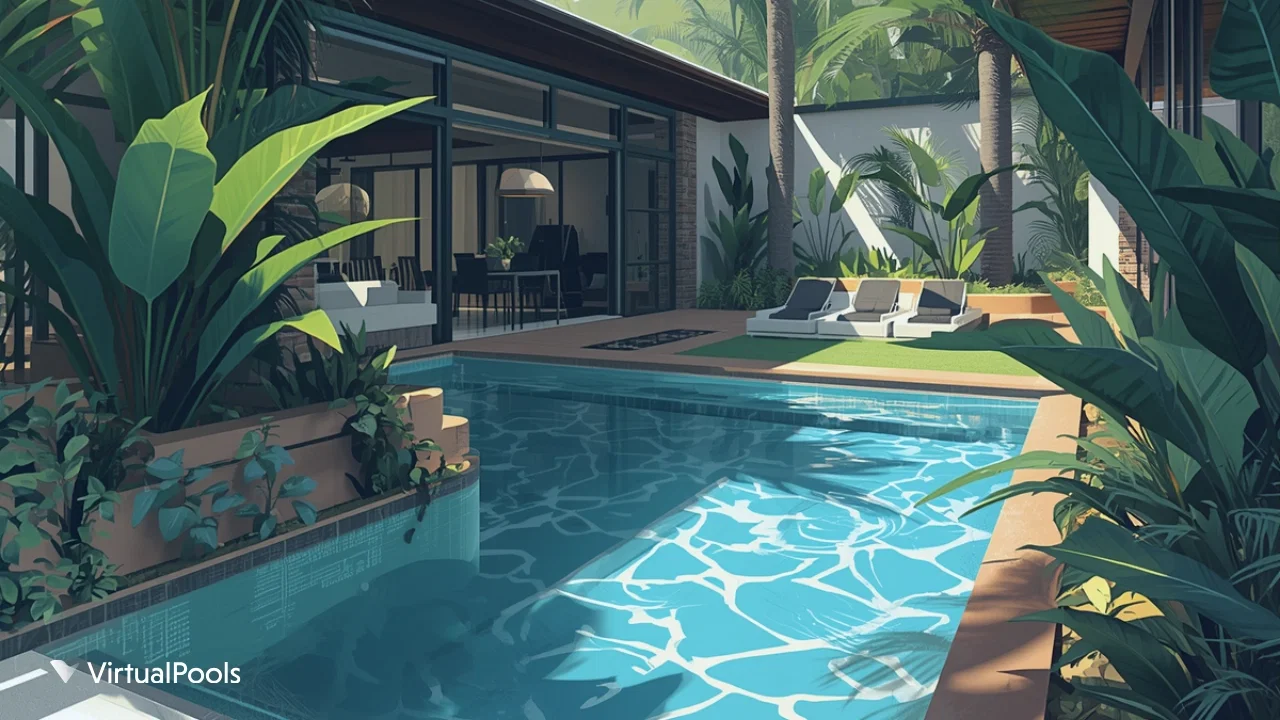
The rapid emergence of generative artificial intelligence (AI) has signaled a fundamental shift in how professionals approach architectural and spatial design. AI models have transitioned from passive analytical tools to active systems capable of generating highly detailed, photorealistic concepts in a matter of seconds.
However, as the initial novelty of AI visualization wears off, pool professionals face a critical reality: creating an inspiring image is not the same as designing a controlled, configurable pool concept that reflects real product choices, site context, and the practical decisions required. Understanding the precise capabilities and limitations of AI, and knowing when to transition to a dedicated 3D sales platform like VirtualPools, is essential for navigating the modern sales landscape.
AI rendering: Rapid conceptualization
The integration of AI in pool and architectural design is undeniably transformative. Generative AI tools, powered by advanced algorithms such as Generative Adversarial Networks (GANs) and Diffusion Models, can process massive amounts of input data almost instantaneously.
When a homeowner provides a photograph of their garden, AI can interpret visual context and generate plausible design directions based on prompts, style preferences, and visible spatial cues. This makes it useful for moodboards, early inspiration, and rapid concept exploration. However, most AI rendering tools do not verify real terrain levels, drainage, sun exposure, wind, access constraints, product availability, or construction feasibility unless they are connected to specialist design, survey, or configuration systems.
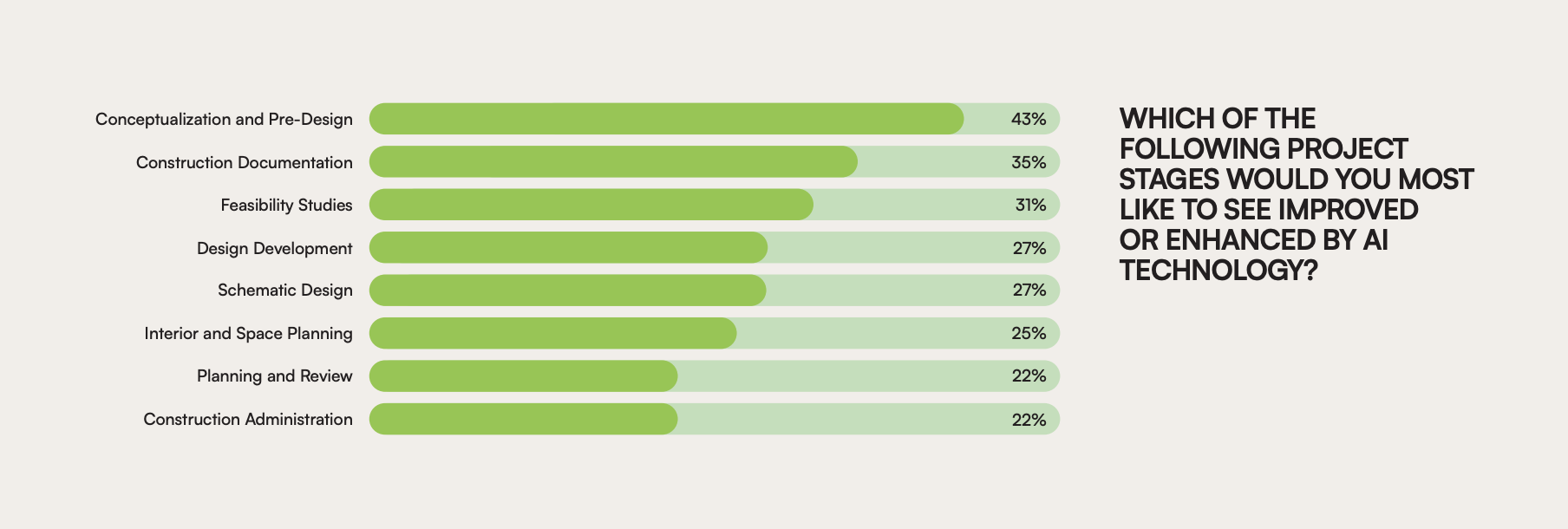
For the pool professional, AI acts as a powerful catalyst during the earliest stages of a project. According to a 2026 industry report by Architizer and Chaos, 43% of surveyed architects and designers who use AI report the greatest time savings during the concept design and ideation phases.
By automating the initial brainstorming process, AI provides high-volume, rapid visual iterations that can evoke a strong emotional response from a client who has never visualized a pool in their backyard before.
Where AI pool rendering falls short in live pool sales conversations
Despite its speed and visual appeal, generative AI possesses fundamental limitations that prevent it from functioning as a standalone sales or design tool. The main limitation is control. AI can generate a persuasive image, but the internal logic of why it placed the stairs in a certain location or how it calculated the terrace dimensions remains opaque to both the designer and the client.
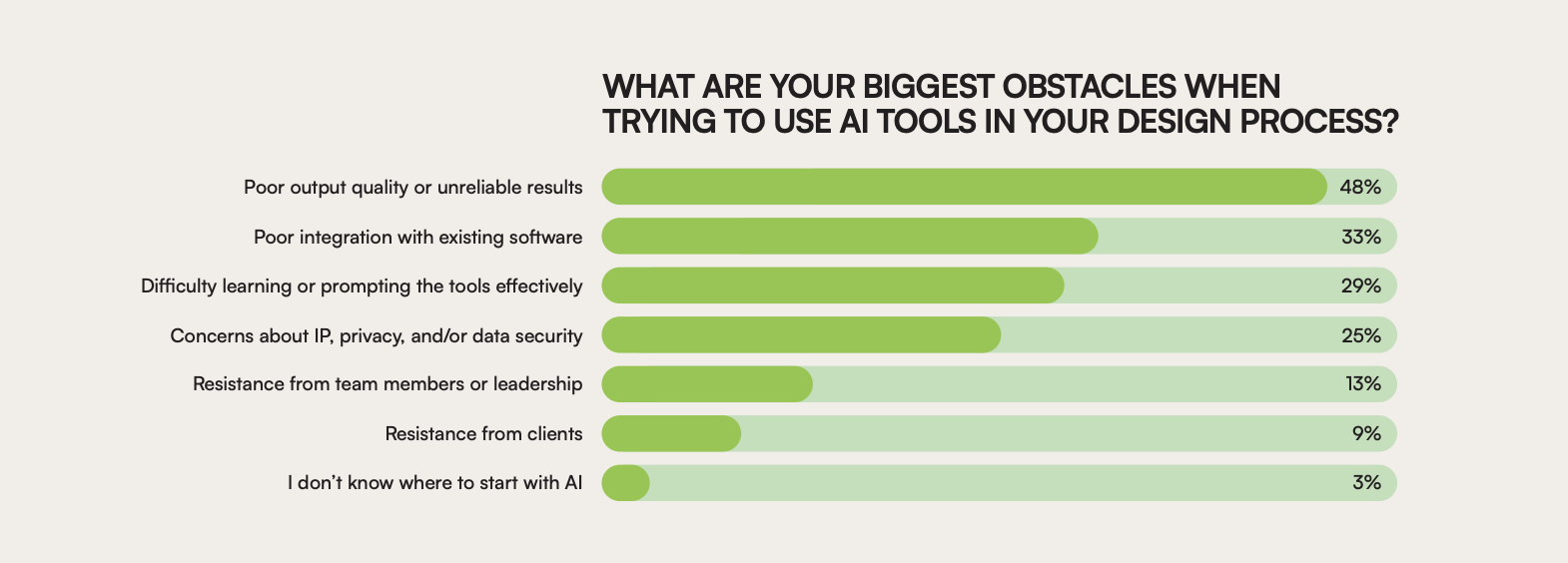
When transitioning from early inspiration to a live, client-facing sales conversation, this lack of precise control becomes a liability. The joint survey by Architizer and Chaos highlights that the primary unmet need among professionals using AI is 'greater control over output images'. Furthermore, 48% of the surveyed designers cited 'poor output quality or unreliable results' as their biggest obstacle.
Even among professionals who use AI successfully, caution remains, 70% of architects say AI visualizations still require professional supervision, while only 17% feel AI outputs are clear and controlled enough to use without significant oversight.
An AI-generated pool image can look convincing without being technically or commercially valid. It may show materials your company does not sell, the exact slope of the client's physical garden, or the precise placement of filtration systems.
This completely disrupts the momentum of a live sales pitch. When a client becomes excited by an AI rendering and asks, "Can we make the terrace a bit wider and change the liner color?", AI cannot dynamically adjust the 3D space. You are forced to re-prompt the system, which generates an entirely new and often inconsistent image, breaking the client's connection to the design.
The transition: from AI inspiration to strategic curation
Because of these inherent limitations, architectural theorists now advocate for professionals to act as "strategic curators" rather than passive consumers of AI outputs. A strategic curator uses AI for initial broad-stroke ideas, but then takes complete control over the technical validity, structural parameters, and exact material specifications.
In the pool industry, this operational bridge between raw AI inspiration and a finalized, signable contract is where VirtualPools enters the ecosystem.
Full control and the branded 3D sales engine
VirtualPools is an all-in-one 3D design, visualization, and sales platform built explicitly for pool builders. If AI is the tool for conceptual dreaming, VirtualPools is the engine for exact configuration and closing the deal.
-
Unlike AI, which guesses dimensions, VirtualPools offers real-time, precise configuration. It allows builders to create custom 3D pool designs in minutes with exact, real-time control over pool size, stairs, covers, lighting, and borders. If a client requests a design change during a meeting, the builder can move the stairs or expand the terrace instantly, keeping the sales momentum alive without having to generate a completely new image.
-
Real product catalogs, while AI relies on generic, approximated textures, VirtualPools operates on actual product catalogs housed within a fully white-labeled experience. The platform integrates specific catalogs directly into the company's configurator. Clients aren't experiencing a generic software product. Instead, they're experiencing a professional design tool that belongs to you. What they see on the screen reflects the products and options your company actually offers, helping bridge the gap between a visual concept and a sales-ready proposal while elevating your brand authority.
-
Augmented reality and spatial context, AI produces a static, 2D picture. VirtualPools solves this through "Live Mode," an Augmented Reality (AR) feature that places a true-to-scale 3D pool directly into the client's actual garden using a tablet camera. The client and builder can physically walk around the design to understand its true spatial context. Furthermore, features like "Hill Mode" seamlessly adjust the pool's altitude for uneven, sloped terrains, while "Human Detection" keeps people visible in the camera frame as the pool renders around them, creating a highly immersive experience.
| Feature | AI tools | VirtualPools |
| Primary Use Case | Rapid ideation and top-of-funnel lead inspiration | Exact design configuration and closing live sales |
| Client Experience | Generic, third-party software output | Fully white-labeled, proprietary branded experience |
| Material Accuracy | Often approximate materials unless linked to a catalog | Exact products from catalogs |
| Design Control | Prompt-based control, consistency varies by tool | Complete (Real-time dimensional configuration) |
| Spatial Awareness | Usually, image-based or prompt-based visualization | True-to-scale 3D Augmented Reality (Live Mode) |
| Handling Revisions | Often requires re-generation or manual follow-up | Instant, interactive on-screen adjustments |
The smarter workflow for modern pool sales
Generative AI should not be dismissed. It is a highly effective, fast-paced tool for top-of-funnel lead generation and rapid visual brainstorming. However, relying on AI to close a complex, high-ticket sale leaves pool builders exposed to unreliable outputs and a profound lack of spatial and material control.
By deploying AI for initial inspiration and utilizing VirtualPools for precise, interactive, and branded 3D configuration, pool professionals can eliminate client hesitation, maintain absolute control over the design, and effectively sell the exact pool the customer intends to buy.